By Vincent Reifer

We have seen our grandparents inherit religion, then push it on our parents, and then that belief system became a part of their domestication. From this inheritance 3 types emerged; Those who received it and genuinely made it their own. Those who made it performative, then those who walked away carrying nothing, no framework, no foundation, no real concept of God at all.
That is what was passed to us. We see the news, we see the scandals, we see the pastors. There is a reason Christians got so upset at Sinners and the Druski skit because it hit home. Not in a good way, but rather in a way that exposed something nobody wanted exposed.
This generation is also deeply interested in religion; the generation that is known to be always on their phone has a real yearning for that connection, a want for the peace that comes from knowing everything is going to be alright because something greater is present. And data backs this up, according to the Springtide Research Institute; a large majority of young people, about 71%, identify as at least slightly religious, and 79% identify as spiritual.
Our generation, yes, we have the ability to see through the smoke and mirrors and get to the root of our religions. This is where spirituality comes in. Spirituality asks us to go deeper than institutions, deeper than rituals, and deeper than labels. It asks us to search for truth, meaning, and connection with each other. The seeking is real. The hunger is there. The hard questions are now being reasked: what is being fed to us, and who benefits from feeding it?
Christianity, as many know it today, was not handed down untouched from the heavens; it was heavily shaped by the Council of Nicaea in 325 AD. During this epoch, Roman Emperor Constantine gathered bishops to consolidate and standardize Christian doctrine. It was more of a political meeting rather than a spiritual one. Texts were selected, others were removed, and an entire tradition was filtered through the agenda of the empire.
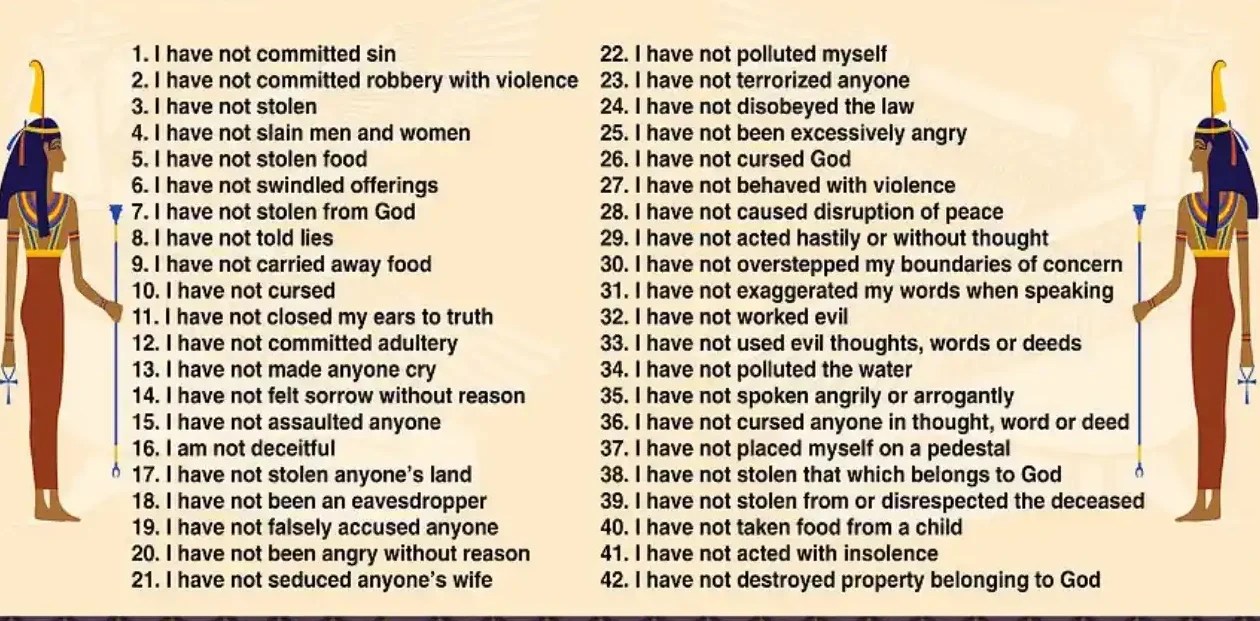
The African roots; the Kemetic concepts, Dogon methods, the afterlife, divine judgment, and the trinity were absorbed, reframed, and the origin was buried. Ausar became the blueprint for Christ. The 42 laws of Ma’at predated the Ten Commandments.
Moses was born in Kemet and lived with the royal family. He would have seen these laws at least 5 times a day because that was the custom. None of this is a coincidence; it is history that was simply never taught in the pew. Sometimes we need to put down religious books and read straight history so we can get a context and understanding of what these stories, allegories, and lessons are truly about.
Even within Islam, there is a growing emphasis among some adherents on maintaining a distinct African cultural identity. This perspective underscores the importance of distinguishing between religious practice and cultural influence, particularly in separating Islamic faith from traditions associated with Arab culture. The Moors proved this with their culture; they had Islamic law but African customs and spirituality. That’s why there was religious tolerance in the Moorish Empires. Because we actually thrive from our differences, it helps us think and grow stronger
Turning the clock back to Kemet in antiquity, what we know today as ancient Egypt. In Kemetic philosophy, spirituality was centered around a principle called Ma’at. Ma’at represented truth, justice, balance, harmony, and the natural order of the universe.
The goal of life was not simply to follow rituals or belong to a religious group. Now this is where we will pause and will be grounded in the fact that Religion is what you profess, spirituality is what you do, and it is worth mentioning that the words spirit, God, and universe are interchangeable. The oldest known name for the divine was not “GOD”. It was PTAH, predating much of Western theological language by thousands of years.
There are many books on the African origins of religions, and they will be listed below. But in Mumia Abu-Jamal’s book Faiths of Our Fathers, specifically this book examines Africa right from before the slave trade and on. This work proves how, even when coming to the so-called “New World,” we grounded ourselves in the African spirituality and customs; thus is how we got spiritual systems such as voodoo and santeria, which can be traced back to the Yoruba or Ifa spiritual systems.
So let us answer the question directly. Does Gen Z need religion? Well, we let people redress something we created, then we let them sell it back to us. We didn’t expect them to enslave us through it.
What this generation needs first is spirituality as the foundation. When you build on spirituality, it enables us to speak in a language we all understand. The person who believes in God and the person still searching can have a real conversation. Spirituality does not ask anyone to abandon what they practice, just understand that everything that you use in your life must be an instrument of your liberation, or you must throw it away.
Does it liberate you? Does it make you more fully human? Does it connect you to your people and your purpose? If yes, then keep it, go deeper, learn more, let it work. And if not, then you already know what to do.
We really need to end these wars between Christians, Muslims and Jews. The only reason why religion has such a bad look is because of the religious corruption, nationalism, war, conquring and blood that has been shed because “My God is better than yours”. And like any child with siblibings we just want to be the favorite. When spirituality becomes the foundation, the fighting over whose building is right stops, and the harder question begins. Are we actually living what we claim to believe?
Ma’at did not ask which temple you attended. She asks if you live in truth? Did you pursue justice? Did you keep the balance? If these ancient Africans were able to build and live under this system, then surely we can have this understanding and common ground once again. The question is now not what you believe in, but what type of humanity do you see with that belief?
Dr. John Henrik Clarke said it best, “A whole lot of people have been hit with a lot less than us and are extinct. Since we have brought the world its first humanity, we have been preserved to give the world its last humanity.”
Religion & Spirituality Texts
- The African Origins of the Major Western Religions – Youef Ben Joccanan
- Christianity before Christ – John G Jackson
- Stolen Legacy – George G.M. James
- Pagan Origins of the Christ Myth – John G. Jackson
- Spirituality Before Religions – Kaba Kamene
- Black Arabia; the African Origin of Islam – Dr Wesley Muhammad
- Beyond Bilal – Mustafa Briggs
- The Myth of Genesis and Exodus and the Exclusion of their African Origins – Yousef Ben Joccanan
- Book of Coming Forth Today from Night/Papyrus of Ani – Translated; E.A. Wallis Budge
 Reclamation Papers